One founder removed free plans entirely from his B2B SaaS product after two years and studied what happened, a decision that sits at the heart of the PLG vs. sales-led growth choice. His conclusion: he had been attracting users who wanted a simple tool, not a comprehensive service. His free users were not his customers. They were people who would never pay, costing him infrastructure, support, and product attention that should have been pointed at the buyers who would.
That is the freemium trap in its clearest form. Not that freemium is wrong. Not that free users have no value. But that a free tier without a deliberate ICP boundary produces a user base that looks like traction and behaves like noise, generating the most feedback from the people least likely to pay.
The median freemium-to-paid conversion rate across B2B SaaS is 2 to 5 percent. Free trials, which require a time-bounded commitment to evaluate the product, convert at 8 to 18 percent for opt-in models and up to 31 to 49 percent for credit-card-required trials. The gap between those numbers is not a product quality gap. It is an intent gap. A free trial user has made a commitment. A freemium user may have signed up to satisfy a moment of curiosity and has no particular reason to return.
Freemium is a distribution strategy, not a positioning strategy. The companies that use it successfully have defined the ICP boundary before launch. Without that boundary, freemium generates user volume at the cost of signal quality.
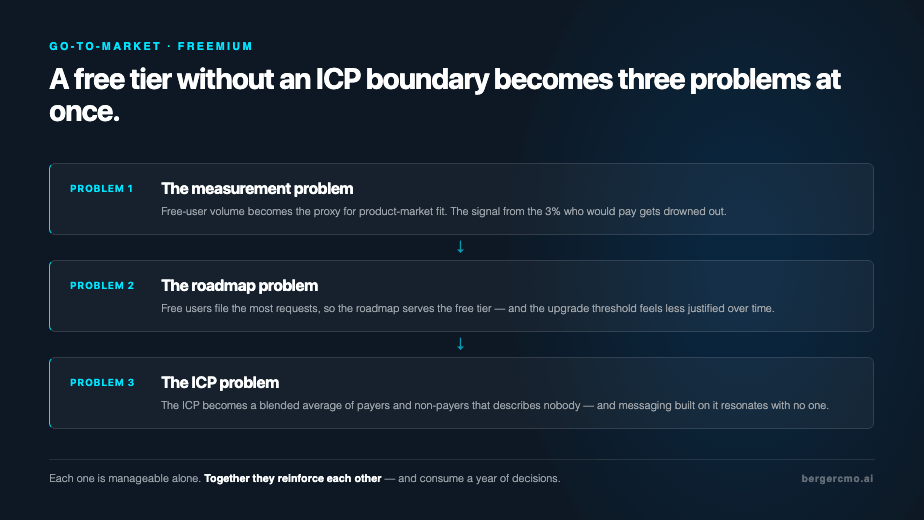
The three problems that compound
The freemium trap is not a single problem. It is three problems that reinforce each other over time. Each one is individually manageable. Together they can consume a year of product and marketing decisions before the company realizes what is happening.
When freemium actually works
None of this is an argument against freemium. Slack, Dropbox, Notion, and Calendly all built significant businesses with freemium as a primary distribution mechanism. The difference between those companies and the ones caught in the trap is not the strategy. It is the conditions.
Freemium works when the product delivers value fast enough that an individual user experiences it before organizational buy-in is required. It works when the free user creates value for others in the organization by inviting them or sharing work, producing organic expansion that makes the free user genuinely part of the acquisition motion. It works when the cost of serving each free user is low enough that the conversion rate covers the overhead. And it works when the free tier is designed around a specific, deliberate ICP boundary rather than just being the full product minus a few gated features.
Calendly's free user did something specific: they sent a scheduling link. The recipient experienced the product. The network effect was embedded in the core action. Notion's free user shared a document. The collaborator needed an account to comment. The freemium tier was not just a free version of the product. It was a specific mechanism for organic spread, designed around a specific user behavior, producing a specific type of new user at the end of the chain.
Most B2B SaaS companies that adopt freemium are not Calendly or Notion. Their free tier is a limited version of the product, offered to reduce friction at signup. That is a reasonable tactic. It becomes a trap when the company starts treating the resulting free user base as a representative sample of its market.
The ICP boundary that makes freemium work
The fix is not removing the free tier. It is defining a specific ICP for the free tier that is either a) a genuine conversion path to paid, or b) a deliberate acquisition mechanism with a known organic spread effect.
If the free tier is a conversion path, it should be designed to get the right user to the upgrade threshold as efficiently as possible. That means knowing which type of user is most likely to convert, designing the free experience around the moment that demonstrates the value they came for, and placing the upgrade threshold where the value of paid features becomes visibly necessary for someone in that specific situation.
If the free tier is an acquisition mechanism, it should be designed to produce a specific type of new user through a specific type of organic action. The spread mechanism should be identified, measured, and optimized deliberately. Free users who do not participate in the spread mechanism are not part of the strategy. They are overhead.
In either case, the ICP for the free tier and the ICP for the paid tiers should be defined separately and clearly enough that product feedback from each group can be segmented before it influences the roadmap. The company that treats all user feedback as equivalent is building for the wrong audience at every tier simultaneously.
The founder who removed his free tier did not do it because freemium is a bad model. He did it because his free users and his paying customers were different people with different needs, and he had spent two years trying to serve both without the ICP clarity to do either well. Once he removed the free tier, the signal cleared. He knew who his buyers were. He knew what they needed. The product and the messaging both got sharper.
That clarity was available before the two years. It required asking a different question than "how do we get more free signups?" The question that would have saved the two years was: who specifically will pay for this, and is the free tier designed to get more of those people into the product, or is it designed to get everyone?
If you have a freemium tier and your conversion rate is not where it should be, segment your free users by ICP fit before changing anything else. A 3 percent overall conversion rate may contain a 12 percent conversion rate for ICP-fit users and a sub-1 percent rate for everyone else. Those require completely different responses, and you cannot tell which one you have without the segmentation.
One caveat: the segmentation is only as useful as the ICP definition it is measured against. If you do not yet have a clear paid ICP, start there first. Running the segmentation against a vague ICP produces a vague answer. Getting the ICP clear and then running the segmentation in sequence is the work, and it is faster to do both right once than to do the segmentation twice. A Marketing Audit builds both in the same process, before you rebuild the pricing architecture around a diagnosis that might not hold →