In April 2020, Jeffrey Katzenberg launched Quibi with $1.75 billion in funding, a roster of A-list talent, and the absolute certainty that people wanted short-form premium video on their phones. He had the research. He had the focus groups. He had the backing of Disney, NBCUniversal, and a dozen more institutional names. He had, by every conventional measure, validated the idea.
Six months later, Quibi shut down.
The post-mortems cited bad timing, a confusing feature set, COVID-19. All true. But the root cause was simpler. Katzenberg and his co-founder Meg Whitman had fallen into what psychologists call the False Consensus Effect: the deeply human tendency to assume that other people want what we want, because we want it. If short premium mobile video sounded compelling to them, it would sound compelling to everyone. The research confirmed it. The focus groups confirmed it. Nobody said no.
Nobody saying no is not the same as the market saying yes.
The question is the problem
Rob Fitzpatrick spent years watching founders get this wrong before he wrote it down. His 2013 book, The Mom Test, is now part of the core curriculum at Harvard, UCL, Seedcamp, and Microsoft Ventures. The thesis fits in one sentence: you should never ask anyone whether your business idea is good.
Not because people will lie. Because the question itself is broken.
When you ask someone "would you use this?" or "do you think this could work?" you are asking a future-tense hypothetical in a social context. And social context has rules. One of the rules is: don't hurt the feelings of someone who is clearly excited about something. So people tell you what the social situation requires. They say it sounds interesting. They say they could see themselves using it. They ask when it launches. Every single one of those responses feels like signal. None of it is.
Fitzpatrick identifies three types of bad data that founders collect in these conversations: compliments, hypothetical fluff, and wishlists. All three feel positive. None of them tell you whether anyone will open their wallet. And all three are exactly what you get when you ask the wrong question to people who care about you.
The problem is not who you are asking. The problem is what you are asking. Better questions work on anyone, including your mom.
What Dropbox did instead
In 2007, Drew Houston had a working prototype of Dropbox, but it was rough. It only ran on Windows. It could not support more than a handful of users at once. It was nowhere near ready to launch.
He did not ask people if they thought cloud file syncing was a good idea. He recorded a four-minute video showing the product working and posted it to Hacker News. The video was embedded with small references designed to resonate with technical communities. It answered one question without asking it: does this problem feel familiar to you?
The answer came back in behavior, not opinions. Dropbox's beta waitlist went from 5,000 to 75,000 overnight. No advertising. No finished product. No survey asking how likely respondents were to recommend cloud storage to a colleague.
Seventy thousand people took an action. That is a different category of information than seventy people saying "yeah, I'd probably use something like that."
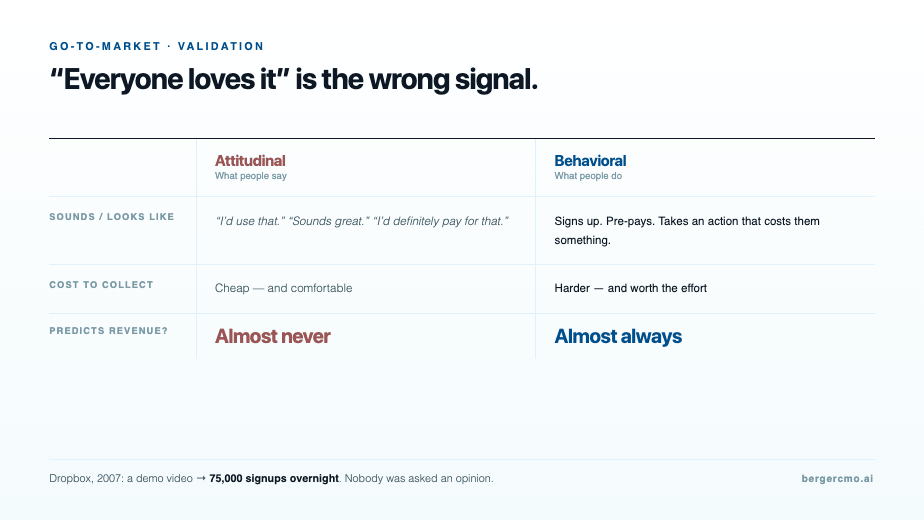
The distinction has a name. Attitudinal data is what people say. Behavioral data is what people do. Attitudinal data is cheap to collect and almost useless for predicting revenue. Behavioral data is harder to collect and almost always worth the effort.
The questions that produce real signal
Fitzpatrick's framework comes down to a single reorientation: stop asking about your idea and start asking about their life. Specifically, their life as it exists right now, not as they imagine it might be if your product existed.
Notice that none of these questions mention your product. That is intentional. The moment you introduce your idea, the social dynamic shifts. The other person starts trying to be helpful about your thing instead of honest about their own situation. You lose the signal.
Why this is a marketing strategy problem, not just a research problem
Here is why this matters beyond the early conversations: every downstream marketing decision depends on the quality of what you learned before you built.
The ICP is built from what you learned about who has the problem. If that learning came from friendly conversations rather than behavioral evidence, the ICP describes a buyer archetype that felt right rather than one that actually buys. The positioning is built from what you learned about how buyers describe their own pain. If that language came from people who were being supportive rather than honest, the positioning will sound like your assumptions, not like your buyers' reality. The content strategy, the sales sequence, the channel priorities. All of it sits on that foundation.
A marketer who inherits a false ICP is not making strategy mistakes. They are faithfully executing a strategy built on evidence that was never real. The problem compounds with every sprint. By the time the CAC numbers come in wrong, the original validation conversations are long forgotten.
This is the part of the go-to-market process where a Portfolio CMO pays for itself before a single campaign runs. Not by conducting the customer research for you. By making sure the research that was done will actually hold up when a real buyer is in the room.
Quibi's founders were not fools. They were human. They wanted something to be true, found evidence that appeared to confirm it, and built a billion-dollar company on top of that confirmation. The evidence just happened to be the wrong kind.
You probably will not raise $1.75 billion before you find out your validation was wrong. But you might spend six months building the wrong product, then hire a marketer to solve a demand problem that was actually a research problem, then wonder why the messaging keeps missing.
The question that saves all of that is simple. Not "would you use this?" but "what are you doing about this right now, and how is that going?"
Ask that. Listen to what comes back. If the answer is painful and specific and expensive, you have something. If the answer is vague and hypothetical and ends with "I'd probably just figure it out," you have a conversation, not a customer.
And if you have already done this work, if you know your buyer, you know their pain, and the GTM still is not clicking, the validation was probably right. The translation was wrong. That is a different problem and a harder one, but it has a specific answer: somewhere between what your buyers told you and what your content and positioning actually say, the signal got lost. Finding exactly where is the starting point. A Marketing Audit maps that gap in 30 days and hands you a positioning brief your sales team can use in the next call. The conversation that kicks it off costs nothing. →