Open five competitor homepages in your market right now. The patterns you find there should directly inform your brand vs. demand generation budget decisions. Read each one. Then swap the logos.
If the copy still makes sense on any of them, you do not have a differentiation problem. You have a category problem. Everyone in your market is describing the same thing in the same language, which means the buyer landing on any of these pages has no way to tell who is actually right for them. They default to the biggest brand name, the lowest price, or whoever got to them first.
That is the thing a competitive teardown should find: where all your competitors are saying the same thing, and what they are leaving unsaid. Not what features they have. Not what their pricing tiers look like. What framing of the problem they have collectively abandoned that you could occupy.
Most competitive analysis does not find this. It finds a feature matrix and a positioning statement and a price comparison, all of which are useful for selling against a specific competitor but none of which change how you describe your own product. The teardown methodology that actually changes strategy asks a different question from the start.
The question most teardowns start with
The standard competitive analysis question is: what do they have that we do not, and what do we have that they do not? The output is a feature grid. Green checkmarks where you win, red X marks where you lose, yellow circles where it is complicated.
That grid is useful for a sales battlecard. It is almost useless for positioning work. Buyers are not comparing feature matrices. They are comparing how each product makes them feel about their problem. The features are evidence for a claim. But what is the claim? And is it the right claim for the buyer who is actually in pain right now?
The teardown question that changes strategy is not "what features do they have?" It is "what problem do they claim to solve, for whom, and is there a framing of that problem they have all left on the table?"
That question requires reading five homepages and asking: what is the buyer being told their problem is? What are they being told the consequences of that problem are? And what alternative are they being compared against? The answers almost always reveal a shared narrative that every competitor has converged on, which means there is a different narrative available to anyone willing to use it.
The four-step methodology that produces insight
This is the teardown process I run when entering a new engagement. It takes two to three focused days. The output is not a slide deck. It is a document that changes what goes on the homepage, in the demo, and in the cold email.
What the teardown actually produces
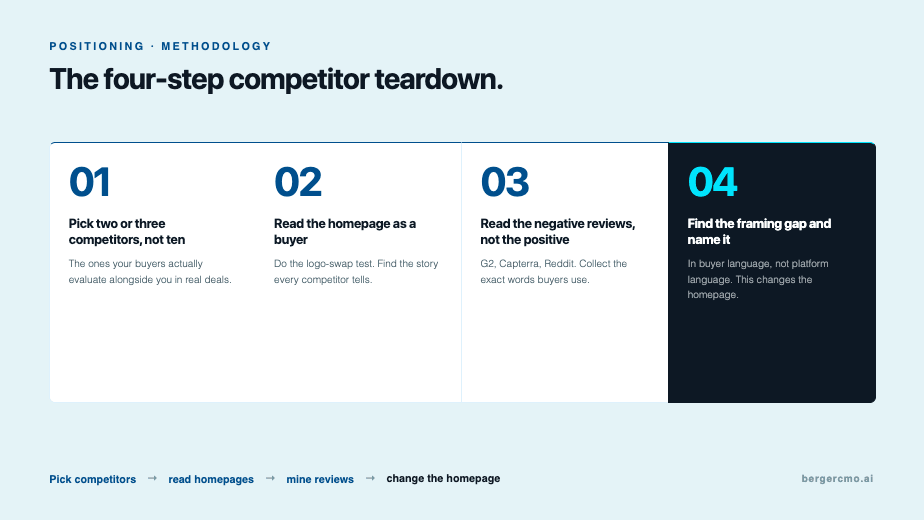
The output is not a battlecard, though the teardown informs one. The output is three documents that change live strategy.
How often and when to run it
Deeply, twice a year. Lightly, whenever a deal is lost to a competitor and the reason is not fully understood.
The deep teardown takes two to three focused days and produces positioning changes that last six to twelve months. The deal-loss teardown takes two hours: pull the lost deal from the CRM, call the salesperson who ran it, and ask two questions. What did the buyer say when they told you they were going with the competitor? And what did the competitor say in their final pitch that you did not have a clear response to? Those two answers almost always surface a specific framing or objection that is not in the battlecard and should be.
Together they create a competitive intelligence loop that is proportionate to the effort and actually changes decisions rather than producing quarterly decks that everyone nods at and nobody acts on.
The logo swap test is worth doing right now, before you plan another campaign or revise another headline. If your homepage copy makes sense with a competitor's logo on it, the buyer cannot tell the difference either. Every click you buy to drive traffic to that page is competing for attention with the exact same message the competitor is running.
The framing gap exists in almost every market. Finding it requires looking at your competitors as a buyer rather than as a competitor, which is harder than it sounds when you know the product well.
One check worth running before you commit to a framing gap: the test for whether it is worth owning is whether the buyers in the negative reviews were actively looking for that framing and not finding it. If buyers are describing a problem in language nobody is marketing around, the gap is real and validated by the people who experienced it. If the gap exists because nobody has tried that framing yet and there is no buyer evidence it resonates, treat it as a hypothesis and validate it in one channel before building a messaging strategy around it. The negative reviews tell you the difference. An empty gap and a real gap look identical on a feature grid. They look very different in the language buyers use when the product does not give them what they came for.
The distance required to see what everyone else is saying is almost always easier from outside the building than inside it. If you want to run this teardown on your market with someone who has done it across dozens of B2B categories, a 30-minute call is where it starts →