In November 2024, HubSpot was the gold standard of B2B content marketing. A Domain Authority score of 81. Over 120 million backlinks. Nearly 14 million monthly organic visitors. Their content team was widely studied, their SEO strategy widely copied. For a decade, they were the answer to "how do we do content marketing well?"
By January 2025, that number was 6 million. A drop of more than 50% in two months.
The post-mortems wrote themselves. Google's December 2024 algorithm update. AI Overviews absorbing clicks. The death of the SEO blog. Every analysis was technically accurate and missed the actual point.
HubSpot didn't lose traffic because the rules changed. They lost traffic because they had spent years building content that had nothing to do with what they sold. Pages ranking for "real estate license." Pages ranking for "cover letter examples." High-volume topics with zero connection to CRM software. The new rules didn't break HubSpot. They exposed the gap between traffic and authority that was already there.
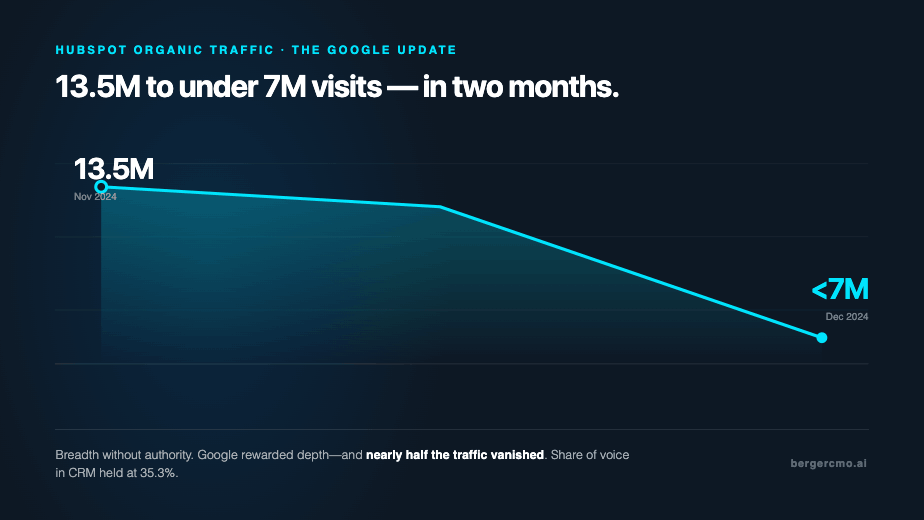
Here's what almost nobody reported alongside the collapse: HubSpot's share of voice in AI-generated answers for its actual category, CRM software, held at 35.3%. In conversations where buyers were evaluating CRM options, HubSpot appeared in nearly every AI response. The machine knew what they were the authority on. It ignored everything else.
The reframe the new acronyms are trying to sell you
Open any marketing newsletter in 2026 and you will find something about GEO. Generative Engine Optimization. Or AEO. Answer Engine Optimization. Or "optimizing for AI search," which is the same idea with no acronym attached. The framing is consistent: this is a new discipline with new rules, and if you are not already running it, you are behind.
Some of that is true. But most of it is a repackaging of the same principle that has governed search visibility since Google's first algorithm update: be specific, be credible, and be clearly about something.
The most rigorous evidence on what actually moves AI visibility comes from a 2024 peer-reviewed study by researchers at Princeton University, Georgia Tech, and IIT Delhi, presented at KDD 2024. They tested nine content modification tactics across 10,000 queries on multiple generative engines. The results were blunt. Adding statistics to content improved AI visibility by 41%. Adding named quotations improved it by 28%. Keyword stuffing, the old SEO tactic, actively hurt performance.
The punchline buried in the methodology: simply adding more words produced zero improvement. The signal AI engines reward is data density and source credibility. Not volume. Not brand voice. Not SEO-optimized headlines written to match a keyword cluster.
AI doesn't reward clever. It rewards clear. And most early-stage B2B marketing is built on clever.
What actually changed, and it's not what the vendors are selling
Traditional SEO rewarded you for covering a topic. AI search rewards you for owning one.
The distinction matters more than it sounds. Covering a topic means writing enough content to appear in search results for a range of related queries. HubSpot did this better than almost anyone for a decade. Owning a topic means being the identifiable authority that machines have learned to associate with a specific category, problem, or type of buyer.
Research synthesizing 680 million AI citations found that brand search volume, not backlinks, is the strongest predictor of whether an AI will cite you. The correlation is 0.334. Traditional domain authority explains less than 20% of AI citation variance. What this means in practice: AI engines surface brands that buyers already associate with a specific thing. They reinforce existing authority rather than discovering new voices.
For an established company, this is mostly good news. For an early-stage company building its presence from scratch, it is a more urgent version of the same problem that has always existed: you cannot build AI visibility on vague positioning. A machine cannot extract and repeat what you do if your homepage says "we help companies grow faster."
The companies that will win AI search citations in the next two years are not the ones who started adding schema markup in Q1 2026. They are the ones who spent 2025 getting precise about who they serve, what problem they solve, and what specifically makes them better than the alternative. That clarity becomes the content. The content becomes the citation.
The conversion argument that should change how you think about this
Here is the number worth sitting with: traffic from AI search platforms converts at 14.2%. Google organic search converts at 2.8%. That is roughly a fivefold difference in conversion rate from a channel that currently accounts for less than 1% of total website visits.
The obvious interpretation is that AI search is small but growing and you should prepare now. That is true. The less obvious interpretation is what the conversion gap tells you about who is showing up.
Buyers who find you through an AI answer have already been through a research process. They asked a question. The AI evaluated available sources. It cited you. By the time they land on your site, they have already heard a version of your answer. They are not browsing. They are evaluating. The content they arrive at needs to be written for someone making a decision, not someone starting a search.
Most B2B company websites are not written for that buyer. They are written for the top of the funnel: broad awareness, category education, light persuasion. That was the right approach when SEO traffic meant people at the beginning of a journey. It is the wrong approach when the buyer arriving has already been pre-sold by an AI citing you as the authority.
What to do before you touch a single GEO tactic
The GEO playbook is real. Structured data matters. FAQ sections matter. Named statistics in your content matter. Heading hierarchies that match buyer queries matter. A restructuring study from 2026 found that reorganizing content structure alone, without changing a single word, lifted AI citation rates by 17.3%.
But none of that compounds if the underlying content has nothing specific to say.
Before you commission a GEO audit, answer these three questions honestly. What specific problem do you solve, stated precisely enough that a machine could extract it as a factual claim? What type of company has that problem, defined narrowly enough that you could name ten that fit right now? And what do you do better than the alternative those buyers are currently living with?
If your answers are vague, your GEO investment will produce citations for the wrong queries, from the wrong buyers, landing on pages that convert at 2.8% instead of 14.2%. The tactic works. The foundation it runs on has to exist first.
In practice, this work has a clear sequence. The first step is a deep content and messaging audit: mapping what your site currently says against what your buyers actually search for, identifying where your positioning is too vague for an AI to extract and repeat, and finding the gap between how you describe your product and how your best customers describe the problem it solves. That gap is almost always where the citation opportunity lives.
The second step is building the content that earns citations. FAQ pages are the most underused AEO asset in early-stage B2B. Not generic FAQ pages, but pages structured around the exact questions a buyer at your stage asks an AI before they book a demo: "What is the difference between X and Y," "How do companies like mine handle Z," "What should I look for in a vendor for W." Each answer written as a precise, sourceable claim, not a marketing paragraph. These pages do double duty. They convert the AI-referred visitor who already trusts you, and they train the model to associate your brand with the query category you want to own.
The output of that process is two things: a positioning brief tight enough to use in sales calls, and an AEO playbook that tells your writer or content person exactly what to produce for the next six months, in which format, targeting which queries. Not a content calendar. A citation strategy with a target list.
In practice, this work has a clear sequence. The first step is a deep content and messaging audit: mapping what your site currently says against what your buyers actually search for, identifying where your positioning is too vague for an AI to extract and repeat, and finding the gap between how you describe your product and how your best customers describe the problem it solves. That gap is almost always where the citation opportunity lives.
The second step is building the content that earns citations. FAQ pages are the most underused AEO asset in early-stage B2B. Not generic FAQ pages, but pages structured around the exact questions a buyer at your stage asks an AI before they book a demo: "What is the difference between X and Y," "How do companies like mine handle Z," "What should I look for in a vendor for W." Each answer written as a precise, sourceable claim, not a marketing paragraph. These pages do double duty: they convert the AI-referred visitor who already trusts you, and they train the model to associate your brand with the query category you want to own.
The output of that process is two things: a positioning brief tight enough to use in sales calls, and an AEO playbook that tells your writer or content person exactly what to produce for the next six months, in which format, targeting which queries. Not a content calendar. A citation strategy with a target list.
HubSpot's story ends the same way it began: with a clarity question. When they published broadly, they built traffic and lost authority. Where they had always been specific, the machines kept citing them. The algorithm didn't punish their size. It punished their vagueness.
You are not HubSpot. You do not have years of misdirected content to unwind. You have the advantage of starting clean, with a choice most established companies cannot make without a painful content audit behind them: decide now what you are the authority on, before you publish anything else.
If you read this post and recognized your own content in the HubSpot pattern, the conversation worth having is specific. Not "help me with marketing." Something closer to: what queries should your company be appearing in, where are you currently absent, and what does the content need to say so a machine can extract it and repeat it to a buyer who is already halfway to a decision.
That is a 30-minute call. Not a proposal. If it sounds like the right conversation, here is where it starts →