Between 2024 and 2026, marketing job postings grew approximately 6 percent year-over-year. Marketing output, measured in campaigns launched, content assets produced, and analytics reports delivered, grew closer to 24 percent. That 18-point gap did not come from longer hours or bigger budgets. It came from AI tooling paired with senior judgment.
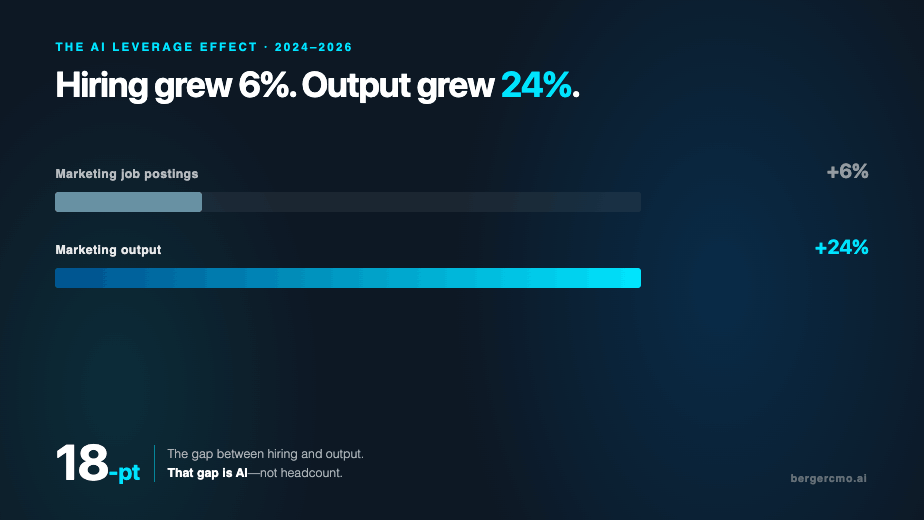
The practical translation for a Series A or B company: the marketing headcount you needed two years ago to produce a given level of output is not the headcount you need today — which changes the in-house hire vs. portfolio CMO calculation significantly. Junior content, research, and coordination work that previously absorbed one to two full-time hires at a company your size is now handled by a senior operator plus a stack of tools that costs roughly $500 to $1,500 per month. The tools do not replace the strategic judgment. They replace the execution hours.
This is not a post about AI replacing marketers. It is a post about the specific functions AI handles well enough that hiring a person to do them is now an expensive redundancy, and the specific functions where human judgment is still the irreplaceable input. Getting those two buckets right is the difference between a lean team that punches above its weight and a team that adopts tools but still operates at the same speed it did before.
What the stack actually covers
For a two to three person marketing team at a Series A or early Series B company, a well-built AI stack covers five functional areas. Each one either eliminates a hire or meaningfully reduces the scope of what a hire needs to do.
The fully loaded cost of this stack sits somewhere between $500 and $1,500 per month depending on tier and usage. The fully loaded cost of the human equivalents, two to three junior hires covering the same functions, is $250,000 to $370,000 annually, before benefits, recruiting fees, and the three to six month ramp time before productivity. The arithmetic is not subtle.
The boundary the tools cannot cross
The functions listed above are execution functions. They take a defined task and produce output from it efficiently. The AI is not deciding what to research. It is not deciding what to write about. It is not deciding which accounts to target or which channels to prioritize. A human with a clear brief is directing every one of those tools. The tool accelerates the output. The human provides the judgment that makes the output worth producing.
AI amplifies what exists. If the positioning is unclear, AI content tools produce more unclear content faster. The risk is not that the tools are ineffective. It is that they are highly effective at doing the wrong thing efficiently.
The functions that remain irreducibly human are the ones that require judgment about buyers, markets, and strategy rather than execution of defined tasks.
The sequence that makes this work
The companies that get this right do it in a specific order. Foundation first, tools second. They establish ICP clarity, positioning, and at least one validated channel before they deploy AI tools at scale. Once those inputs exist, the tools accelerate everything downstream. Before those inputs exist, the tools accelerate in the wrong direction.
The companies that get it wrong reverse the sequence. They adopt tools early because the tools are cheap and fast and available. The content calendar fills up. The outbound sequences go out. The SEO briefs get written. Six months later, the pipeline is not moving and nobody can tell whether the messaging was wrong, the channel was wrong, or the ICP was wrong, because everything was deployed simultaneously from an unvalidated foundation.
The practical implication for an early-stage company making its first real marketing investment: the most valuable thing is not the tools. It is one senior person with the judgment to set the foundation, direct the tools, and interpret what comes back. That person running a well-built AI stack produces more useful output than three junior hires working without that direction. The budget that would have gone to three hires now goes to one hire plus a stack plus program spend. The output goes up. The noise goes down.
The fully loaded cost-per-marketer at B2B firms sits between $180,000 and $420,000 when you include salary, benefits, tools, and program budget, per the CMO Council's 2026 benchmarks. The question worth asking before the next headcount request is not "which role do we need?" It is "which of the functions in this role require human judgment, and which ones can a tool handle with senior direction?" The answer almost always means fewer hires at a higher level with a better stack underneath them.
That is not a prediction about where AI is going. It is a description of where it already is. The teams winning in 2026 are not larger than the teams losing. They are better directed.
The distinction between an AI-augmented junior marketer and a senior operator directing AI tools is not tenure or title. It is whether the person can look at what the tools produce and decide whether it is right, not just whether it ran. That judgment requires knowing what good looks like for your specific buyer. It is why the tool direction role and the positioning role are almost always the same person at an early-stage company. When they are separate, the tools run efficiently in whatever direction the junior person points them, which may or may not be the right one.