Here is the hire pattern I see at most Series A B2B companies: the company raises, the board asks about pipeline, the CEO posts a job for a head of demand gen or a growth marketing manager, and three months later there is a new person running LinkedIn campaigns and Google ads with a vague brief and a quarterly pipeline number they have no realistic path to hitting.
Six months after that, the campaigns are not converting, the CEO is frustrated, and the new hire is spending their days optimizing ad copy on a message that was never right in the first place.
This is not a demand gen problem. It is a sequencing problem. If you're deciding between hiring in-house vs. bringing in a portfolio CMO for Series A, that choice is foundational before any execution hire. And it costs most Series A companies six months and $150,000 to find that out.
What demand gen actually requires to work
Demand gen is an execution function. It takes a proven message, points it at a validated audience, distributes it through channels that have demonstrated they convert, and scales what works. Every word in that sentence matters.
Proven message. Validated audience. Channels that have demonstrated they convert.
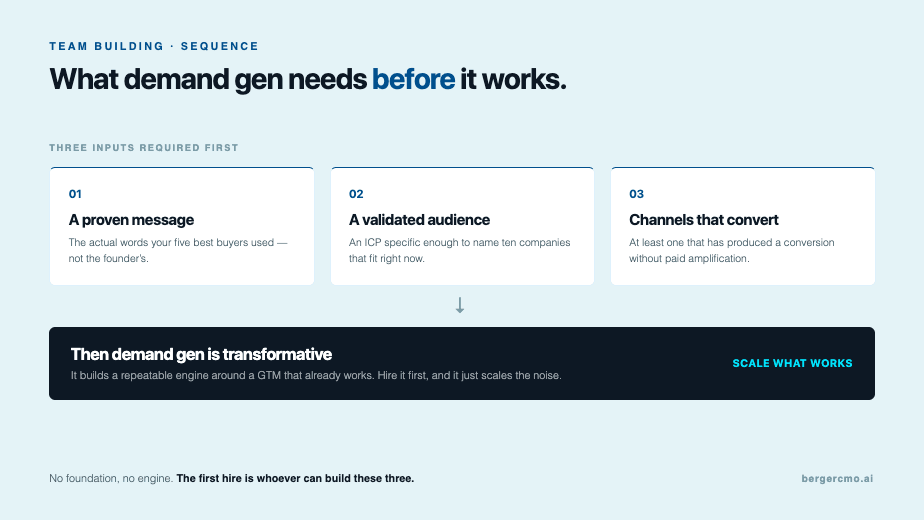
When those three inputs exist, a good demand gen hire is transformative. They can take a working GTM and build a repeatable engine around it. When those three inputs do not exist, a demand gen hire fills the gap with whatever they know best, which is usually the channels they have worked in before, pointed at the broadest reasonable interpretation of the ICP, distributing messaging that the founding team wrote without having talked to enough buyers.
Scale amplifies what exists. If the GTM foundation is broken, demand gen makes it more expensive to fix, not easier. The campaigns are not the problem. The brief the campaigns were written from is the problem.
This is not a failure of the demand gen hire. It is a structural mismatch between what the role requires and what the company has built. Demand gen hired before the foundation is set will always fill the vacuum with execution. That is what the role is for. The mistake is creating the vacuum in the first place.
The three questions that determine whether demand gen is the right hire
Before posting a demand gen job description, a Series A founder should be able to answer three questions with specifics. Not broadly. With specifics.
If those three questions cannot be answered cleanly, the first marketing hire is not a demand gen person. It is whoever can answer them.
What that hire actually looks like
The function that answers those three questions is not demand gen. It is positioning and messaging: the work of finding out who the best buyers are, what they actually say, and which channels those buyers pay attention to. That work is done by a product marketer, a founding content lead, or a fractional CMO who builds the brief before the programs start.
The right first hire is determined by what the CEO cannot do, not by what marketing is supposed to do. Most Series A CEOs are excellent at selling. They have closed twenty to thirty deals personally. They know the product deeply. What they often cannot do is step back far enough from their own assumptions to hear what buyers actually say, write it down in buyer language rather than founder language, and build a content and channel strategy from those inputs rather than from instinct.
That gap is the first hire. It is a strategic gap, not an execution gap. Hiring execution into a strategic gap produces programs that work efficiently in the wrong direction.
When the CEO has closed thirty deals personally, can articulate the ICP in a sentence, and knows which channel produces the best pipeline quality, the first hire can be demand gen. That company exists. Most Series A companies are not that company yet.
When demand gen is the right call
None of this is an argument against demand gen. It is an argument about sequence. Demand gen is one of the highest-value functions in a mature GTM. The companies winning at pipeline in 2026 have demand gen programs running that compound over time: organic content building search authority, paid channels optimised against real ICP conversion data, outbound sequences built from messaging that has been validated in real sales calls.
Those programs work because they were built on the right foundation. The foundation did not come from the demand gen hire. It came from the work that happened before the demand gen hire was made.
The question is not whether to hire demand gen. It is whether the inputs that demand gen needs are ready. Running full-funnel campaigns before the bottom of the funnel is working, before the demo-to-close rate is clear, before the messaging has been tested against real buyers, produces top-of-funnel pressure on a system that is not ready to convert it. That is not a channel problem. It is a sequencing problem with a channel-sized price tag.
The most expensive hiring mistake I see at Series A companies is not a bad demand gen hire. It is a good demand gen hire made six months too early, before the foundation existed for them to build anything on. The hire does their job. The campaigns run. The leads come in wrong. The blame lands on demand gen when the actual failure happened at the job description stage.
If you have already made the hire and the pipeline is not moving, the fix is not a new channel. Run the three-question audit against your current programs: is the ICP specific enough to name ten companies, is the messaging derived from buyer language or founder assumptions, and has any channel produced a conversion without paid amplification? Rebuild the brief against those answers before the next campaign cycle starts, not after. The hire is not the problem. The brief they were given is.
The 30-minute call I offer is useful at both moments: before you post the job description, and after the campaigns are running but the pipeline is not. Either way, the question is the same. That answer costs nothing to find out and is worth considerably more than another campaign cycle in the wrong direction →