The conversation happens in some version at almost every company I have worked with. Marketing presents a pipeline coverage number in the board meeting. The number looks healthy. The board approves the budget. The quarter closes and the number did not convert. Sales blames marketing. Marketing blames sales. The CEO is frustrated with both.
What nobody says out loud is that the pipeline number was always fiction. Not a deliberate lie. A structural one. Marketing was measured on pipeline generated. Budget was justified by that number. So the number grew to justify the budget, not to reflect genuine buyer intent. The fiction bought time. The cost compounded quietly, in a currency that does not show up in the dashboard: the trust between the two teams that makes everything downstream work.
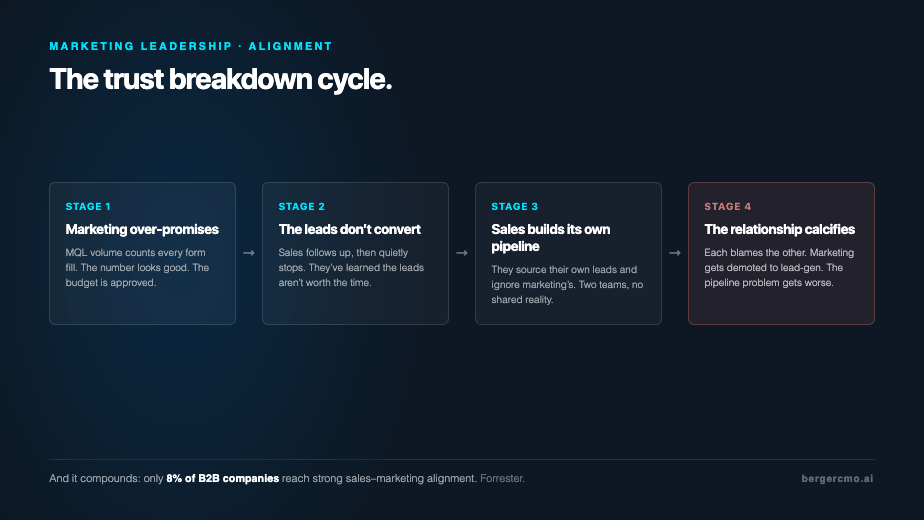
Only 8 percent of B2B companies have achieved strong sales and marketing alignment, according to Forrester research. The number has not improved in years, despite endless alignment initiatives and smarketing frameworks and shared Slack channels. The reason it has not improved is that the structural incentive that creates the fiction has not changed. Marketing is still goaled on volume. Sales is still goaled on revenue. Those two optimization functions guarantee conflict when the volume does not convert.
How the fiction compounds
The trust breakdown does not happen all at once. It happens in stages, each one making the next harder to reverse.
Companies with tight sales and marketing alignment enjoy 19 percent faster revenue growth and 15 percent higher profitability on average, according to SiriusDecisions (now Forrester). They close deals at 67 percent higher rates, per Marketo research. Misalignment is estimated to cost over $1 trillion in lost revenue annually, according to HubSpot. The cost is not the bad quarter. It is the organizational damage that makes every subsequent quarter more expensive to run.
Why it is structural, not personal
The CMO who inflates pipeline numbers is almost never doing it out of dishonesty. They are doing it because the incentive structure requires it. If you are measured on pipeline generated and your pipeline is not covering the quarter's target, you face budget cuts or a performance conversation. If you redefine the MQL threshold slightly more broadly, the pipeline number improves. You buy another quarter. The leads do not get better. The number looks better.
The fiction is not a character problem. It is a measurement architecture problem. The moment marketing is goaled on a metric that can be improved without improving the underlying quality, the metric will be improved without improving the underlying quality.
This is why the standard advice to "align on shared goals" does not fix the problem. You can put marketing and sales in the same meeting every week and share the same dashboard and still have the incentive mismatch producing the same behavior. The pipeline number will grow to justify the budget as long as growing the pipeline number is how the budget gets justified.
The fix is not alignment theater. It is a measurement architecture that makes it impossible to improve the metric without improving the quality. The metric has to be one that sales validates, not one that marketing self-reports. SALs and SQLs meet that test. MQL volume does not.
What the fix actually requires
Three things. They are not complicated. They are just uncomfortable, because each one requires marketing to accept accountability for outcomes it does not fully control.
A written lead definition built from closed-won data. Not what marketing can produce. Not what sales ideally wants. What the ten best customers looked like at the point of first sales contact. Company size, job title, engagement behavior, trigger event. That profile becomes the SAL definition. A lead that does not match it does not count toward pipeline, regardless of how many forms it filled out.
A feedback loop that requires sales to report on every lead received. Not "we followed up" or "this went nowhere." Specific disposition: qualified and active, not yet ready, wrong ICP, already a customer, unreachable. That feedback tells marketing which sources are producing leads that sales actually touches, and which sources are producing volume that goes into the graveyard between MQL and SQL that practitioners describe as "where deals go to die."
Marketing goaled on SALs and SQLs, not MQLs. This is the change that actually moves the behavior. A marketing team goaled on SAL and SQL rates will produce fewer leads at higher quality, because the metric penalizes volume that does not convert. It will also tell the board an honest story about pipeline coverage: here is how many qualified, ICP-fit, sales-accepted opportunities we produced this quarter, here is the close rate on that cohort, and here is the revenue we expect from it over the next 90 days.
That story might be a smaller number than the MQL story. It will be a more accurate one. And over time, it is the story that earns the trust that makes marketing's budget requests survive a CFO question.
The way to frame this internally without it feeling punitive is to position it as raising the bar, not changing the target. Marketing has been hitting a number that nobody in sales was acting on. The new number is smaller and harder to reach, and every lead that meets the definition will be followed up. That is a more important number to hit than a large one that gets ignored. Most marketing leaders, when they hear that framing honestly, would rather own a smaller number that matters than a large one that does not.
The MQL number that got the budget approved last quarter is almost certainly the reason sales stopped trusting marketing last year. The two facts are related. The pipeline fiction that justifies the spend is the same fiction that makes the spend less effective, because the sales team it is supposed to serve has learned to work around it.
I have watched this cycle play out at enough companies to know that breaking it requires someone willing to report a smaller, honest number rather than a larger, comfortable one. That conversation is easier to have before the relationship breaks than after. If you want to rebuild the measurement architecture before the next budget cycle rather than after, a 30-minute call is the right place to start →