Go-to-market strategy for B2B SaaS is the sequence of decisions that determines how your company finds, reaches, and converts its best buyers. At Series A, the five decisions that matter: who your ICP actually is based on who has already bought, what positioning your buyers respond to in their own language, which motion fits your product and ACV, which channels reach the validated ICP efficiently, and which metrics tell you whether it is working. Most founders make all five correctly but in the wrong order. That is why campaigns look busy and do not compound.
GTM strategy is not a document
I have worked through GTM strategy with B2B SaaS companies at Series A more times than I can count, and the most common pattern is the same every time. The company has a GTM strategy document. It sits in a Notion folder. It was written during the fundraise. The sales team has never read it and the marketing team cannot find it.
That document is not the strategy. The strategy is the set of active decisions shaping how every sales rep opens a conversation, how every campaign is targeted, how every hire is sequenced. Those decisions exist whether or not they are written down. The question is whether they were made deliberately, in the right order, based on evidence about what your buyers actually do.
The founders who get GTM right do not have better ideas. They make the decisions in the right order, with evidence, and they update them when the evidence changes.
The five decisions, in sequence
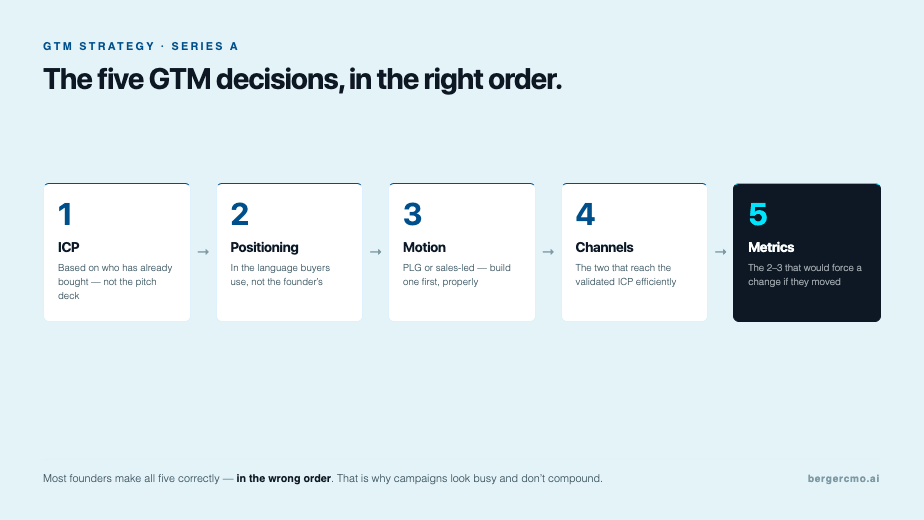
Decision 1: Who is your ICP, based on who actually bought?
The ICP in the pitch deck is a hypothesis. The last fifteen closed deals are evidence. These are almost never identical. Pull those deals and map who was actually in the buying room, what triggered the evaluation, what alternatives they considered, and what made them say yes. The differences between that map and what the deck says are what you need to know before making any other GTM decision.
Research from Gartner found only 42% of companies formally document their ICP, and most have not updated it in over a year. A 2026 study found that over 50% of prospects pursued by B2B sales teams do not fit the company's own stated ICP. Those are not prospect problems. They are ICP problems. And they make every downstream GTM decision wrong by definition.
For the full framework on how to run this exercise, including the three questions to ask each closed-won customer, see the Series A marketing strategy guide.
Decision 2: What is your positioning, in buyer language?
Positioning is not a tagline. It is the specific answer to why this buyer, at this moment, should choose you over the thing they are doing now. Written in the language buyers use in the evaluation conversation, not the language the founding team uses to describe the technology.
The gap between what the website says and what the sales team says in calls is the most reliable indicator that positioning has not been done. Every company I have worked with has had this gap. Closing it is not a copywriting exercise. It is an interview exercise: ask your five best customers what made them say yes, in their words, at the specific moment they decided. That language is the positioning. The MVP positioning test covers how to validate it cheaply before it goes anywhere public.
Decision 3: What is your primary motion: PLG or sales-led?
This is the decision most founders avoid because it feels like foreclosing options. It is not. It is choosing which motion to build first so it actually works, rather than running two motions at half-speed and having both underperform.
PLG works when: the product delivers value before purchase, the buyer can evaluate without a sales conversation, and ACV is low enough that the economics of self-serve make sense. Sales-led works when: the deal requires a champion, involves a buying committee, or the ACV justifies the cost of human-driven conversion. These are not values. They are constraints from your product and your market.
Many Series A companies run both. Most run both too early, before either is working properly. The result is two motions competing for the same rep attention and the same buyer conversation, with neither producing the pipeline clarity that would tell you which to invest in further.
Decision 4: Which channels reach your validated ICP?
Channel selection happens after ICP and positioning are validated. Running LinkedIn ads with an untested message is expensive. Running outbound sequences with an unvalidated ICP wastes rep capacity. Most Series A companies can run two channels well. The selection criteria are simple: where is the validated ICP concentrated, and what can the team realistically resource?
The most common mistake is choosing channels based on what the founding team is comfortable with rather than what the evidence about the ICP indicates. The founder who loves content does not necessarily have an ICP that is best reached through content. The decision should be made from the ICP map, not the founder's preference.
Decision 5: Which metrics tell you if the strategy is working?
Two or three metrics that would require a change in strategy if they moved in the wrong direction. Not metrics that confirm the strategy is working. CAC payback period by ICP fit. Trial-to-paid conversion by source. Net revenue retention by cohort. These numbers often exist in the data but are not being surfaced because nobody built the query. Building the reporting infrastructure to see them clearly is part of the GTM strategy, not a downstream operational task.
Most Series A marketing dashboards track what is going right. The more useful dashboard tracks the two or three numbers that would tell you the strategy needs to change. CAC payback under 12 to 18 months is the Series A benchmark. Series B investors will ask for it. Build the visibility before you need it.
The GTM decision library
The five decisions above each split into a set of more specific choices that depend on your company's stage, ACV, and motion. The guides below address the most common binary decisions founders face at Series A, with a framework for each:
The three GTM mistakes that cost the most at Series A
Selecting channels before ICP and positioning are validated. The result is campaigns that look busy and do not convert. The fix is not better campaigns. It is making decisions one through three before making decision four. See also: why demand gen is almost never the right first hire at this stage.
Treating the pricing page as a sales page. At Series A, the pricing page is doing more strategic work than most founders realize. It signals market type, ICP fit, and value framing in a way that affects every inbound lead before a human touches it. Getting this wrong costs pipeline that is invisible in your attribution model. The pricing page is often doing the wrong job.
Hiring for the GTM motion you want instead of the one you have. The first marketing hire should fit the stage of the motion, not the eventual vision for it. Hiring a demand gen manager before positioning exists is the most common and most expensive mistake at Series A. The first marketing hire framework covers this in detail.
The GTM strategy questions above are the questions a senior marketing leader should own. If the CEO is still making these decisions at Series A, the company has a leadership gap in the marketing function, not a strategy gap. The strategy becomes clear once the right person is making the decisions in the right order.
If you want to understand what building this out looks like at a company at your stage, a 30-minute call gives you a clear picture of where in the sequence you are and what comes next.