Read your hero headline right now. The big line at the top of your homepage, the first thing a visitor sees. Read it once.
Could it appear in your pitch deck without changing a word?
If the answer is yes, you have a problem. Not a design problem. Not a copywriting problem. A structural one. The pitch deck and the homepage serve opposite audiences with opposite needs, and the language that works for one will almost always fail the other.
How every early-stage company ends up here
The sequence is almost universal. A founding team builds a pitch deck. They present it to investors. The deck gets refined over dozens of conversations until the narrative is sharp, the category is clear, and the market opportunity is legible to anyone evaluating it for funding. By the time the Series A closes, the pitch deck is the single best articulation of what the company is that the team has ever produced.
Then someone needs to write the website.
The founding team reaches for what they know: the deck. The homepage becomes the pitch deck translated into web copy. Market position, platform architecture, the competitive moat, the category they are defining. It sounds impressive. It reads like a company worth funding. And it converts at a fraction of what it should, because the person landing on it is not an investor evaluating an opportunity. They are a buyer trying to figure out whether this product solves a problem they have right now.
These are not the same reader. They are not asking the same questions. And they do not need the same piece of writing.
What each audience actually needs
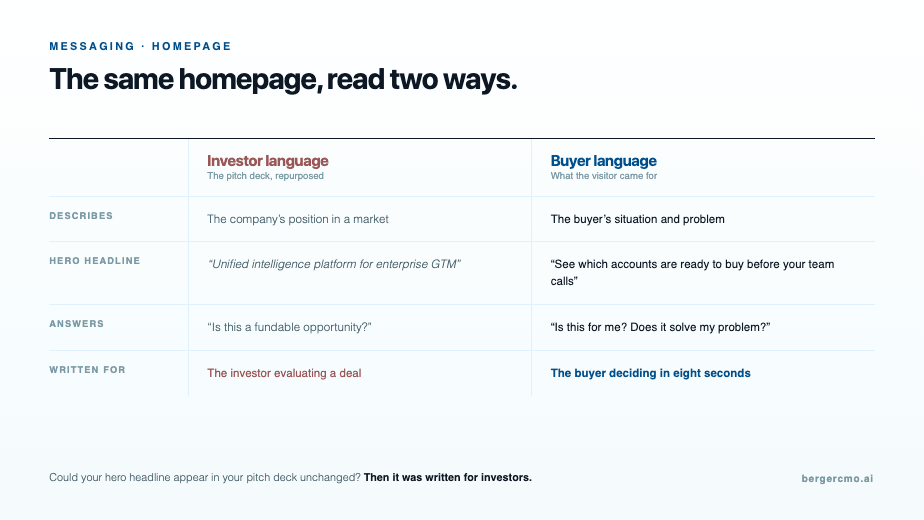
An investor evaluating a deal needs to understand market size, category dynamics, why this team wins, and what the return looks like. They are evaluating an opportunity. The language that serves them is expansive: TAM, platform, operating system, intelligence layer. These words signal category thinking and market ambition.
A buyer who has never heard of your company and landed on your homepage from a search result or a LinkedIn post needs to understand three things in about eight seconds: is this for me, does it solve my specific problem, and what happens if I click the button. They are not evaluating an opportunity. They are evaluating whether this is worth the next five minutes of their attention.
B2B buyers spend only 17 percent of their buying time meeting with potential suppliers. The rest happens on your website, in your emails, and in comparisons they run without you. The homepage is not a pre-sales tool. For most of the buying journey, it is the sales conversation.
The words that signal ambition to an investor signal abstraction to a buyer. "The operating system for modern revenue teams" tells an investor: large TAM, horizontal platform, category leadership ambition. It tells a buyer almost nothing about whether the product solves the specific problem they came to the site to solve.
The difference is not simplicity. The buyer-facing headlines are not simpler. They are more specific. They describe a situation the buyer recognizes, a problem they can see in their own work, and a change that is worth clicking to understand better. The investor-facing headlines describe where the company sits in a market. Buyers do not care where you sit in a market. They care whether you solve their problem.
What the language gap costs
Average B2B SaaS visitor-to-lead conversion rates sit at 1.5 to 2.5 percent. The top 10 percent of companies hit 8 to 15 percent on the same traffic. Hero sections with clear, specific value propositions convert 35 to 40 percent better than clever or ambiguous messaging, according to WebStacks research. A single percentage point improvement, going from 2 to 3 percent, cuts customer acquisition cost by 15 to 25 percent.
None of that requires redesigning the site. It requires changing what the site is saying and to whom it is speaking.
The stakes extend beyond conversion rate. Gartner's research connects decision confidence directly to deal quality: buyers who feel confident in their decision are twice as likely to report a high-quality outcome than buyers with low confidence. Confused messaging does not just reduce the number of visitors who convert. It reduces the quality of the deals that do close, because buyers who arrive uncertain about what you do stay uncertain through the sales process. The homepage problem is a deal velocity problem and a deal quality problem long before it is a conversion rate problem.
The three-question test
I use three questions to audit a homepage in the first ten minutes of any engagement. They do not require analytics access or user research. They require honest reading.
The fix is not a redesign
The most common response when a company recognizes this problem is to commission a website project. New design, new copy, new structure. That is almost always the wrong scope. The design is not the problem. The language is the problem. And the language cannot be fixed by a designer or a copywriter who was not in the room when the buyers told you why they bought.
The fix is a single question answered well: what is the specific problem a specific buyer has right now, and what specifically changes if they use the product? That answer lives in sales call recordings, in the language of closed-won customers, in the words buyers use in their first email when they reach out. It almost never lives in the pitch deck.
Once you have it, the homepage change is usually straightforward. Swap the hero headline. Rewrite the first two sentences of the subhead. Make sure the first call to action describes something the buyer wants, not something the company wants to give them. The structure does not need to change. The subject needs to change, from the company to the buyer's situation.
What that translation looks like in practice: I worked with a company whose hero read like an investor thesis, something about "unified pipeline visibility for revenue operations." Clear to an investor. Opaque to a buyer. After sitting with twelve sales call recordings, one phrase kept coming up from buyers: "I finally know which deals are actually moving." We made that the test. The new hero became: "Know which deals are actually moving before your next forecast call." Same product. Same audience. The language came from buyers describing the moment the product changed their week, not from the founding team describing the product's place in the market. That is the only source the homepage should be drawing from.
I look at the homepage in the first hour of every engagement. It is almost always the fastest signal of whether the company is speaking to buyers or to investors, and it is almost always fixable in a week once the buyer's language has been surfaced from the sales calls and customer conversations that have been happening for years without anyone writing them down.
The pitch deck got you funded. It is not what gets you customers. Those are different documents and they deserve to stay that way. If you want to know which one your homepage currently is, a Marketing Audit answers that in the first session →