Fractional CMO retainers span a wide range: $3,000 to $15,000 a month for advisory-only support, up to $15,000 to $40,000 or more for a full team handling execution. That range is meaningless on its own, because most founders benchmark it against the wrong number. The instinct is to compare a fractional CMO retainer to a marketing coordinator's salary. The comparison that actually matters is against the fully loaded cost of a full-time CMO hire.
If you want a structured framework for working through this decision, the Founder's Marketing Workbook walks through the hiring sequencing question specifically. Not because a fractional CMO and a full-time CMO are identical, but because they are solving the same problem. Senior marketing leadership. Strategic ownership of the pipeline number. Someone accountable at the executive level. If you are weighing whether to bring in a fractional CMO, the question you are actually asking is: compared to what?
The real cost of a full-time CMO hire
The base salary for a senior CMO in 2026 runs $225,000 to $300,000 for most B2B SaaS companies at growth stage, according to Built In's 2026 compensation data. Stop there and the math already looks different. But base salary understates the actual employer cost significantly.
Add benefits, payroll taxes, and retirement contributions. The U.S. Bureau of Labor Statistics puts benefits at 28 to 35 percent of cash compensation. Add a performance bonus target of 25 to 50 percent of base. Add equity, because a CMO who will not take equity is either very risk-averse or has a good reason to expect a short tenure. The loaded annual cost for a mid-market CMO lands at $275,000 to $400,000 before you have found the person.
Then find the person. Executive search firms charge 25 to 35 percent of the placed executive's total first-year compensation. On a $300,000 package, that is $75,000 to $105,000, paid to the recruiter. On a $400,000 package, the search fee alone can exceed $125,000.
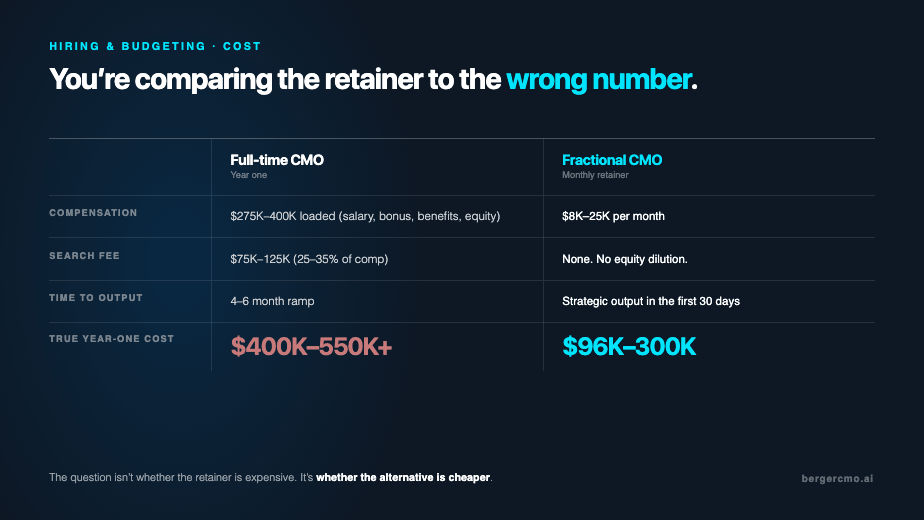
The true first-year cost of a full-time CMO hire, including search, compensation, and benefits, frequently exceeds $400,000. That is before the role drives a single pipeline dollar.
Now add the ramp. A full-time CMO who is new to your company typically takes 90 to 180 days before they are driving measurable output. That is three to six months of full executive compensation while the hire is still learning the product, the customers, and the team. Most fractional engagements produce useful strategic output within the first two to three weeks.
And one more number. Spencer Stuart's CMO tenure study, published in January 2026, found that the average CMO tenure at S&P 500 companies is now 4.1 years. It is the shortest tenure of any C-suite role. At smaller companies and growth-stage startups, turnover happens faster. If the hire does not work out in year one, you start the search process over.
What the retainer actually buys
Fractional CMO retainers in 2026 fall into recognizable bands. Winston Francois, a fractional CMO with 20 years of experience, published a clear breakdown earlier this year. Pricing under $8,000 per month typically buys consultant-level work, not embedded executive presence. The $8,000 to $15,000 range covers 10 to 15 hours per week with mid-senior operators at companies under $10M ARR. The $15,000 to $25,000 range covers 20 to 25 hours per week with experienced CMOs at companies between $10M and $30M ARR.
What you are buying in that range: someone who owns a number, runs the function, directs the team, reports to the CEO, and is accountable to pipeline metrics. Not a strategy document delivered and forgotten. Not a set of recommendations you implement yourself. An operator who is in the work.
Full-time CMO hire, year one (conservative): $275K salary + $96K benefits and bonus at 35% + $82K search fee at 28% = $453,000+. Measurable output starts month 4 to 6.
Fractional CMO, year one starting at $10K/month: from $120,000. No search fee. No equity dilution. Strategic output starts week 2 to 3.
The question is not whether the retainer is expensive. It is whether the alternative is cheaper.
The range above covers the fractional CMO market broadly, everything from advisory-only support to full-team execution. The numbers below are specific to what a bergerCMO engagement costs: a solo embedded model starting at $10,000 a month.
| Cost Factor | Fractional CMO (starting at $10K/mo) | Full-Time CMO Hire |
|---|---|---|
| Annual cost | From $120,000 | $275K–$400K salary + bonus |
| Executive search fee | None | $75K–$125K (25–35% of comp) |
| Equity dilution | None | 0.25%–1% typical grant |
| Benefits & payroll taxes | None | 28–35% of cash comp |
| Time to first output | 2–3 weeks | 90–180 day ramp |
| True year-one cost | From $120,000 | $400,000–$550,000+ |
When this model makes financial sense
There is a stage at which a fractional CMO is clearly the right call, and a stage at which it is clearly not. Knowing the difference matters.
The model works well at Series A and B when the GTM motion is still being defined. The team is small, a full-time CMO would be hard to attract at a competitive comp, and the founders need senior strategic input without the overhead. It also works well during transitions: between CMOs, post-funding while the strategy is being reset, or when the company needs to compress timelines on a specific initiative without making a permanent hire.
It works less well when you need a large execution team below the CMO, when the company has scaled past $30M ARR and needs a full-time executive presence, or when the board specifically wants a named full-time CMO for credibility reasons. In those cases, the fractional model is the wrong tool.
The cost nobody talks about
There is a cost that does not appear in any pricing guide. It is the cost of the wrong first move.
At Series A, the sequencing decisions you make in the first six months of building a marketing function are hard to undo. The wrong first hire. The wrong channel. The wrong ICP definition. The wrong GTM motion for your product and ACV. Each of these compounds. A wrong full-time CMO hire, discovered at month eight, costs you roughly $300,000 in comp and search fees, six months of runway on marketing spend the CMO directed, and another four to six months to find and ramp a replacement.
That is not a hypothetical. It happens. The Spencer Stuart data on CMO tenure is partly explained by exactly this dynamic at growth-stage companies.
The question worth asking before you hire is not "can we afford a fractional CMO?" It is "what does it cost us to get this wrong?"
If the answer to that question runs into the hundreds of thousands of dollars and 12 lost months, the retainer starts to look different.
One other route worth knowing about: fractional CMO agencies and collectives, where a firm assigns you a CMO from their roster. The pricing on that model often looks similar to a solo engagement. What you get is different. You are buying the firm's methodology, not a specific person's judgment, and the CMO you work with is one of many clients that operator is serving across the firm's book of business. For some companies at the right stage, that is the right fit. For Series A and B founders still defining their GTM motion, it usually is not. If you want a direct comparison of the agency model against working with a solo embedded CMO, see the full fractional CMO pricing breakdown.