The CMO has the shortest average tenure of any C-suite role. Most of the early decisions that determine success or failure — including the ones in the Series A Decision Library — get locked in during the first 90 days. Not the most volatile. Not the most competitive. The shortest. Spencer Stuart's 2024 CMO Tenure Study puts the Fortune 500 average at 4.2 years, with technology companies at the short end of that range. In my experience at early-stage and mid-market B2B tech, the number sits closer to 18 to 24 months. Nearly half of U.S. CEOs were unaware CMOs had the shortest tenure in the C-suite as of early 2025.
This is not a talent problem. The people taking CMO roles at B2B companies are experienced, smart, and motivated. The failure pattern is almost always the same and it starts in the first 90 days.
A company brings in a marketing leader. The board wants pipeline. The CEO wants to show investors that marketing is finally working. The sales team wants leads that actually close. The pressure to launch something, anything, is immediate. So the new CMO launches. They run campaigns on top of messaging that was never examined. The leads come in weak. The sales team loses confidence. The board loses patience. Eighteen months later the search begins again.
I have watched this happen at companies that had real products, real market opportunity, and real budgets. The campaigns were not the problem. The sequence was.
What the first 90 days are actually for
The work that matters most in the first 90 days is almost never the work the company hired for. It is not the rebrand, the new campaign, or the demand gen engine. It is the audit.
Specifically: closing the gap between what the company says it does and what buyers actually hear. That gap exists in almost every early-stage B2B company I have worked with, and it is almost always the root cause of the pipeline problem the company thinks better campaigns will fix.
Most inbound B2B SaaS visitors leave without understanding the value clearly enough to buy. Running more campaigns to drive more of those visitors is not a growth strategy. It is an acceleration of the underlying problem.
The best-performing B2B SaaS companies convert inbound visitors at upwards of 10 percent, according to First Page Sage's conversion benchmark data. Most early-stage SaaS companies hit 2 to 3 percent. The difference is rarely the product. It is almost always the clarity of what the product does, for whom, and why it is better than what the buyer is currently doing. That is a positioning and messaging problem. And it cannot be solved by a campaign.
The first 90 days exist to find that gap, name it precisely, and fix it before a dollar of campaign budget is spent.
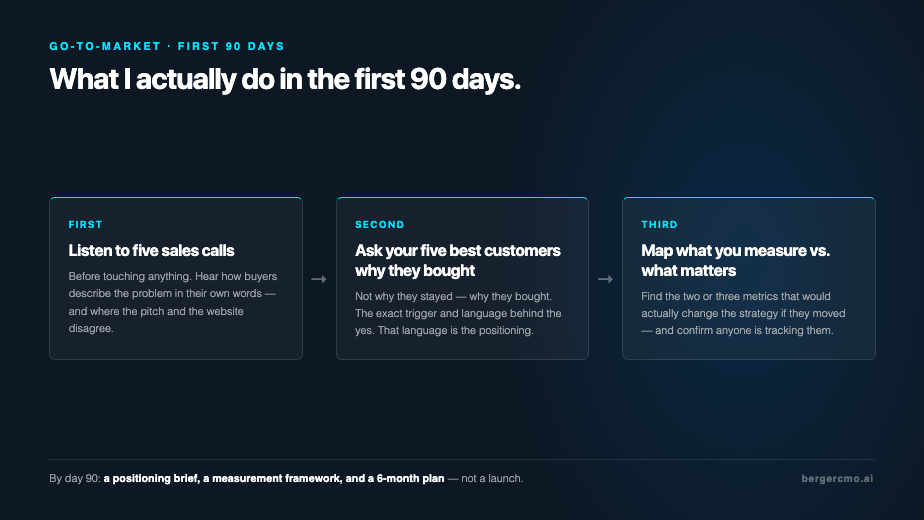
The three things I actually do
This is not a framework. It is what I do, in this order, every time.
What this actually produces by day 90
None of this looks like a launch. There is no press release, no new campaign, no redesigned homepage at the end of week four. I have had CEOs ask me whether I was actually doing anything in the first month. That question is fair and I welcome it, because the answer is the clearest explanation of what the engagement is for.
By day 90 the deliverables are three things.
These three deliverables are not glamorous. They do not look impressive in a board update. But every campaign, every piece of content, and every channel decision built on top of them performs better than whatever came before. Not marginally better. Measurably better, because the message finally matches what the buyer already believes about their own problem.
Why the sequence matters more than the speed
The pressure to move fast in the first 90 days is real. I feel it in every engagement. The company has been waiting for marketing to work. The board wants proof. The sales team has been asking for better leads for two years.
But the marketing leaders who skip this work to show early impact are the ones running campaigns on top of a message that was never right. When the pipeline numbers come in weak, they run more campaigns rather than examining the message that was never examined. The underlying problem compounds with every sprint. By the time the CMO is replaced, the company has spent a year and a significant budget making noise in the wrong direction.
The work I describe here is not slow. It takes 30 to 45 days. What it produces makes the next 12 months faster, cheaper, and more predictable. CAC payback shortens when messaging clarity improves. Sales cycles compress when the buyer's language and the company's language align. The foundation does not feel like momentum. It produces it.
I started this post with the CMO tenure stat not to be provocative but because it is the most honest signal I know of that something structural is wrong with how companies think about the first 90 days. Eighteen months is not enough time to build a marketing function. It is barely enough time to fix the foundation and start running. The leaders who try to skip the foundation and go straight to the campaigns are the ones who run out of time before the numbers move.
The first 90 days are not a performance. They are the work that makes performance possible.
You can run the three conversations described here yourself. Most founders do not get what they need from them, not because of time, but because the person asking the questions is also the person who built the answers. The gap between what you say and what buyers hear is almost impossible to see from inside the building. That is the specific thing an outside perspective adds, and it is the reason the positioning brief looks different when someone who was not in the room when the product was built writes it.
If you are evaluating what a fractional CMO actually does in the first 90 days at a Series A or B company, that is the conversation a 30-minute call is built for. No proposal. Just a direct conversation about what the foundation work looks like for you →